
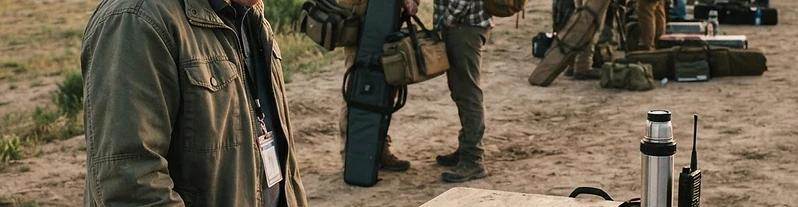
A precision rifle match is not complicated to run. It is a hundred small things done in the right order, most of them for the third or fourth time. The clubs that look effortless on Saturday are not doing anything secret. They are doing check-in, squadding, scoring and results in a sequence where nobody is waiting on the same answer twice.
What follows is that sequence, from the week you pick a date to the hour you post results.
1. Decide what the match actually is
Before a shooter ever sees the match, four decisions lock everything else in place.
- Format. Precision rifle, Hunter, Hunter 3-1-0, BlackJack, Coyote, ELR or Time-Plus. The format decides what a card looks like, what the board ranks on, and what your officers need to know. Pick it first, because everything after it is downstream.
- Capacity. Firing points times relays, minus any seats you deliberately hold back. Capacity is what makes a waitlist mean something.
- Divisions and classes. On a Hunter match the bands are weight and power factor. On an ELR match they are weight and caliber ceilings. Write them down before registration opens, because a shooter picks a division at entry and moving them later is a conversation rather than a click.
- Entry fee and how it is paid. Set the standard fee, any tiers under it (youth, paid club member), and any extras (lunch, a shirt). Decide whether money comes by card, by Venmo or Zelle, or at the desk in cash.
2. Open registration with the right questions
The entry form is the only place you get information for free. Every field you leave out becomes a question shouted across the check-in table at 7:40 on match morning.
Ask for the division, the rifle details the match actually uses, the award tags (Lady, Junior, Senior, Veteran, Military/LE), a squad preference, and the waiver. On a Team Hunter match ask for a partner, and give the shooter a way to say they are shooting solo instead. If the course allows more than one entry per category, say so at entry rather than discovering it at the desk.
Two switches are worth a decision before you open the match.
- Waitlist on or off. On, a full match queues shooters and you promote them as entries withdraw. Off, it turns people away. For a club match the waitlist is almost always right, because somebody always drops on Thursday night.
- Invite-only or held seats. If the club wants a guest list or sponsor places, hold those seats back from public entry rather than overbooking and apologising.
3. The week before is where the match is actually run
Saturday is execution. The match is decided on the Wednesday before it.
Review the roster. Who is unpaid, who has withdrawn, who is sitting on the waitlist, who has not signed a waiver. Chase the money now, politely, rather than at the desk.
Build the squads. Decide capacity per squad from firing points, not from comfort. Assign a start stage to each squad so two groups never open on the same target. Keep pairs, families and travelling partners together, and keep the junior with the adult who brought them. Spread experience, because four first-timers opening on your hardest stage costs everyone an hour.
Check officer coverage. Every stage needs an officer assigned before the match goes live, and a stage with nobody on it is a stage that stops the match. If volunteers signed up themselves, confirm the ones you are counting on rather than hoping.
Send one note to the field, and only one: start time, check-in time, round count, what to bring, whether a chamber flag is required, and what happens if it rains. Then print what the desk needs, because the printer always fails on Friday night when it fails.
4. Match morning: the desk
One table, one queue, one person who owns the answers.
Sort the roster two ways, by name and by squad, because half the field knows their squad and half knows their own name. For each shooter: confirm identity, confirm division, weigh and chronograph where the format scores from it, mark the waiver, take the money, mark them paid, and hand over the card or the squad sheet.
Walk-ups get entered at the desk, into the same list, not written on a scrap of paper to be typed in later. Decide the rule in advance: take them until capacity, then put them on the waitlist.
Mark no-shows rather than deleting them. The roster you post is a record of who was there.
5. The safety brief, and going hot
Stages stay cold until the match director declares them hot, and a ceasefire overrides that on every screen and every pad the moment it is called. Say the brief once, to everyone at once, and stamp it as delivered. A shooter who arrives after the brief gets it individually, before they touch a rifle on the line.
6. On the line
Each shooter gets a card per stage. The officer enters the score, the shooter confirms it, and the card locks. Once locked, only the match director can change it, and the change is recorded against what it replaced. That single rule ends most arguments before they start.
Protests need a window, a fee and a ruling, in that order. Announce the window at the brief so nobody has to guess whether they can still object.
7. When the signal dies
Ranges are holes in cell coverage, and the pad in your hand is the least reliable computer at the match. Scores entered on a pad should stay on that device and push to the match when the connection comes back, with the card saying plainly whether it is saved or still held locally. Never ask an officer to re-type a card they already entered once.
8. Finalize
Before you publish, walk the course: every stage has every card, every shooter has a result or a documented DNF, and the two cards everybody knows are wrong have been looked at. Then settle protests and publish.
Publish what people actually came for: division podiums, category podiums, and the stage-by-stage breakdown so a shooter can see where they lost it. If the match counts toward a season, post the points with the drop rule and the finale multiplier applied as written.
9. Afterward
Count the money against the roster and write down what the match cost. Keep the audit trail of who changed what. Send results to the field once, not three times. And write a short note to whoever runs it next year, because the thing that makes a club good at this is that nothing lives only in one person's head.
None of this requires a sanctioning body, a sponsor, or a committee. It requires a club that decides what it is running, and then runs it the same way every time.
A note on where a platform helps and where it does not: software will not pick your divisions or hold your safety brief. What it can do is stop the same information being written down twice, stop a squad opening on the wrong stage, and make the board correct the first time it is posted. Everything else is the club.