
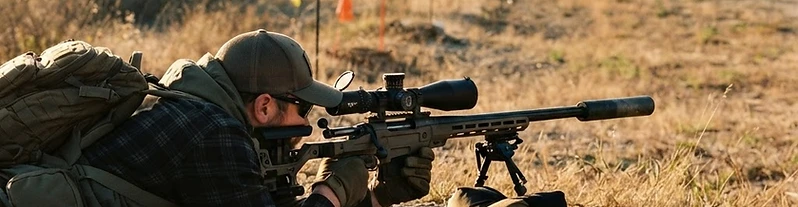
Hunter matches sit between pure precision rifle stages and actual hunting. You are shooting a precision rifle at known or partially known distances, but the positions are awkward, the terrain is rarely flat, the vegetation is real, and the clock is running. A clean wind call that works from prone on a flat range can fall apart the moment you are off a barricade or a rock with the wind wrapping around a ridge. At the distances that matter in most Hunter stages—roughly 400 to 700 yards—the same breeze that is a nudge inside 300 yards becomes the difference between a solid hit and a miss you cannot afford.
Everyone on the stage is shooting roughly the same wind. The shooter who reads the local conditions better, commits faster, and corrects off the splash wins.
What You Are Actually Reading
Wind is three questions. You need all three before you can hold anything useful.
- Speed. How hard it is blowing, in miles per hour.
- Direction. Where it is coming from, on the clock face. The target is 12 o’clock, 6 o’clock is behind you, 3 is to your right, 9 is to your left.
- Value. How much of that speed is working broadside against the bullet. A full-value wind is 3 or 9 o’clock and pushes nearly the whole of its speed. A wind from 12 or 6 pushes almost none of it.
Multiply speed by value and you have the one number that matters: effective wind. Ten miles an hour from 2 o’clock is worth roughly 8.5–9 miles an hour of drift. The same 10 from 1 o’clock is worth about 5. Seven from 7 o’clock is worth about 3.5. Say it out loud that way and your holds stop being guesses. Small changes near 12 or 6 can reverse the hold direction; changes near 3 or 9 matter less.
For a typical 140-grain 6.5 Creedmoor or similar Hunter-match load, a 10 mph full-value wind at 600 yards moves the bullet on the order of a mil to a mil and a quarter (roughly 20–28 inches, depending on velocity and BC). That is often the width of the target or more. Inside 400 yards the same wind is frequently inside the plate if you are close. Past that, it decides the stage. Every number is approximate and load-dependent—verify your own drift with a ballistic solver at your verified velocity before you trust any chart.
Terrain and Thermal Wind Behavior
Flat-range wind reading is only part of the picture in Hunter matches. Terrain and daily heating create local patterns that change the call between the walk-up and the position.
Wind wrapping a ridge or berm often arrives from a different direction (or at a different speed) once you are on the downwind side. The side of the feature facing the wind is compressed and accelerated; the lee side can be calmer or even reverse. In a draw or saddle the wind funnels and speeds up. Vegetation on the floor of a draw may show a stronger or different direction than the grass on the open ridge you just left.
Thermal winds are common in open country. In the morning, as the ground heats, air rises upslope. In the late afternoon or evening it cools and drains downslope. These flows are often light but consistent, and they can oppose or reinforce the prevailing wind. A stage that faces uphill in the morning may see a light headwind component that disappears by afternoon. Watch the direction vegetation is leaning relative to the larger terrain features and the time of day.
The practical rule is simple: the wind at the position and along the bullet’s path can differ from the wind you felt on the approach. Take one more look once you are settled.
Read the Terrain, Not the Forecast
A phone app or the airport reading is almost useless once you leave the firing line. In a Hunter match the wind is a local conversation between ridges, draws, trees, and the heat coming off the ground. The only forecast that counts is the one you read from the position you are actually shooting from.
- Vegetation and dust. Grass laying over, the undersides of leaves showing, a plume of dust drifting off a berm or a dry wash. These tell you about ground you cannot see into and are often more reliable than a distant flag.
- Terrain. A ridge, a cut bank, a line of trees, or a berm between you and the target will shelter, funnel, or reverse the wind. In Hunter stages this is common. If the wind feels different once you settle into the position than it did on the walk up, believe the position.
- Flags and streamers. When they exist, use them, but do not trust only the one at the firing line. A flag that stands out and then drops means the wind is switching, not that it is calm. Prefer the indicator closest to the target and prefer mirage over both when they disagree.
- Other shooters. Splash, trace, and the way the shooter ahead of you landed are free information. Watch where they hit and ask what the wind did if you have the chance. In a timed Hunter stage you may only get a second or two of this, so take it.
Reading Mirage
Mirage is the highest-resolution real-time tool you have for the air your bullet actually flies through, and it costs nothing. It is heat shimmer caused by air of slightly different temperatures bending light. Because the air is moving, the shimmer leans and flows in the direction of the wind. In a Hunter match—where flags are sparse, positions are awkward, and the terrain creates its own local winds—mirage is often the only reliable look you get at the mid-range and target-area air.
Set your focus roughly halfway to the target, or somewhere between one-third and two-thirds of the distance. The goal is to make the shimmer sharp while the target itself softens. Focusing dead on the target shows you air the bullet has already left; focusing too close to the muzzle shows you air that may not represent the rest of the flight. In practice, start with the target roughly in focus, then dial back until the mirage pattern is clear and the target is slightly soft. On a spotting scope this is easy. On a rifle scope it is still possible if you have a moment before you settle into the position or if you can glance through high-power binoculars.
The patterns are consistent once you have seen them a few times:
- A vertical boil (shimmer rising straight up with little sideways drift) means nearly no crosswind component at that distance. The wind is either calm or running almost straight toward or away from you (near 12 or 6 o’clock).
- A slight lean or slow drift means a light crosswind, typically 1–3 mph of effective value.
- A steeper lean (around 45 degrees) and more noticeable flow means moderate wind, roughly 4–7 mph effective.
- A fast, flat run with the shimmer leaning hard and moving quickly means stronger wind, often 8–12 mph or more. Above about 10–12 mph the pattern flattens and speed becomes harder to judge precisely, though direction remains clear.
Mirage shows the effective crosswind at the distance you have focused, not the raw wind speed. An 8 mph wind from 1 o’clock (half value) looks a lot like a 4 mph full-value wind. That is useful: you are seeing the component that actually moves the bullet.
In Hunter stages, scan more than one focus point when time allows. Wind can be calm near you, stronger in a draw, then calm again near the target. A quick look at mid-range mirage, then another near the target, tells you whether the condition is consistent or layered. Prefer mirage over flags when they disagree; the shimmer is reading the air the bullet is actually traveling through. Even a two- or three-second glance through a spotting scope or binoculars before you get on the gun is usually enough to confirm or adjust the call you made on the walk up.
Making the Wind Call
The wind call is the moment you stop gathering information and turn it into a single number and a hold. In a Hunter match this has to happen quickly, often while you are already settling into an awkward position with the clock running. The process is the same whether you are calling for yourself or for a partner.
Start with the local reading at your position—what the Kestrel or the nearest vegetation and flags are showing—and convert it to effective wind using the clock and value. Then adjust that number based on what the mid-range and target-area indicators are telling you. If the mirage at halfway is running harder than the flag at the firing line, increase the call. If the wind is wrapping around a ridge and the vegetation near the target is laying the other way, reverse or reduce it. The goal is one clear effective wind number, not a list of observations.
For switching or gusty conditions, bracket the call. Note the low and the high you are seeing (for example, “six to ten from three o’clock”) and decide which end of the bracket you are going to shoot. Most of the time you shoot the predominant condition rather than the average. Say the call out loud before you break the shot: “Eight effective, left, one mil hold.” Hearing it forces the decision and reduces the chance you will second-guess yourself once you are on the gun. If you have a partner, the call is even shorter—“eight left, one mil”—so they can confirm or challenge it in one sentence.
Once the call is made, commit to the corresponding hold and send the first shot. Do not keep refining the call while the reticle is on the target. The impact (or the miss) is the next piece of data. If you are high or low of the call, correct the hold for the next round and note why the first call was off. Two or three shots later you are no longer predicting; you are shooting the actual wind the stage is giving you. Under time pressure the quality of that first call matters more, which is why the work of watching the previous shooter and taking one quick mid-range look is worth the seconds.
A good wind call is specific, short, and finished before the trigger is pulled. Everything else is preparation.
Working with a Spotter or Partner
A second set of eyes is useful only if the communication is short and the roles are clear. The shooter owns the final call and the trigger. The spotter’s job is to feed the most relevant observation quickly, not to narrate everything they see.
Useful information under time pressure is limited: direction and effective speed, whether it is switching, and whether mid-range or target-area indicators disagree with the firing-line reading. “Left, six to nine, mirage running harder at halfway” is enough. “I think it’s left but the grass near the berm is moving right and the flag at the line is only three” is too long. Agree beforehand on a short format so neither of you has to interpret the other.
When the two of you see different things, the spotter states the disagreement once and the shooter decides. “Firing line is five right, mid-range mirage is eight left—your call.” The shooter picks one, says the hold, and shoots. Arguing while the clock runs costs more than a slightly imperfect first shot. After the impact the two of you can compare notes for the next round or the next stage.
Mental Shortcuts and Field Wind Cards
You will not have time to open a solver on most Hunter stages. Build a small set of numbers you can recall for your load at the distances you shoot most often.
Know what 5 mph and 10 mph full-value winds do at 400, 500, and 600 yards for your rifle. Most people can remember three or four pairs of numbers (for example, “600 yards is about 1 mil for 10 mph full value”). Half-value is half the hold; three-quarter value is roughly 0.85 times. Once you have those anchors, scaling is fast: a 7 mph effective wind is a little less than the 10 mph number, a 12 mph wind is a little more.
A simple field card in your data book or on the back of a range card can list those anchors plus the clock-value multipliers. Glance at it on the walk-up if needed, then put it away. The goal is to turn “eight effective left” into a hold in your head without arithmetic once you are on the gun.
First-Round Hit Strategy vs. Corrective Shooting
Stage rules and time pressure decide how much you invest in the first call. When the stage has a tight par time, limited rounds, or a single high-value target, treat the first shot as the one that counts. Take the extra second to finish the call, commit to the hold, and accept that you may not get a free corrective round. In these stages under-calling or second-guessing the hold is more expensive than a slightly imperfect first call.
When the stage gives you more time or multiple shots on the same target, you can afford a more aggressive first shot. Make a solid call, send it, and be ready to correct immediately from the splash. The first round becomes data rather than the only chance. Many Hunter stages fall somewhere in between—enough time for one corrective shot if the first one is close. In those cases a confident call that is within half a mil of the truth usually leaves you with a chance to clean the target.
Secondary Effects That Get Mistaken for Wind
Not every miss left or right is wind. Spin drift on a right-twist barrel pushes the bullet slightly right as distance increases; at 600 yards it is usually a few inches for a typical 6.5 or .30, enough to notice but not enough to dominate a real wind call. Light conditions can shift apparent impact if you are looking through heavy mirage or if the target is backlit. Position-induced errors—cant, inconsistent cheek weld, or a bag that shifts under recoil—also move the impact and are easy to blame on wind when the stage is positional.
When a shot lands in a place that does not match the indicators you saw, note both the call and the result. If the same error appears on a calm stage or from the same position, it is more likely spin drift, light, or position than an invisible wind. Correct for the known effects and keep the wind call honest.
The Best Wind Reader Is Your Own Bullet
Your first shot is data, not a mistake. At the distances typical of Hunter stages a decent scope will show you the splash, and a heavy 6.5 or .30 will often show you its own trace. That is the wind talking directly to you. Take the read, send the shot, watch the impact, and correct. Two or three rounds of that and you are no longer predicting the wind—you are shooting it. Time pressure makes this harder, which is why the initial call has to be close enough that the first or second round is still on the plate.
Hold, Do Not Dial
Dial your elevation and hold your wind. In a Hunter match you are often already dealing with awkward positions, bag work, and a clock. Cranking a turret for every wind change costs more time than it saves, and you will usually be two shots behind the condition. Set a clean, known hold—half a mil, eight-tenths, a full mil, whatever the call says—and correct the hold as the wind moves. Keep your reticle on the target and your corrections in the glass. If the position forces you to break your cheek weld to dial, the case for holding becomes even stronger.
Sample Wind Calls and Scenarios
600 yards off a barricade, switching left wind. Vegetation at the position is laying left at about 6–8 mph. Mid-range mirage is running left and leaning harder than the near flags. Target-area grass is also left. Call: “Left, eight to ten, shoot nine. One mil hold.” Commit, send the first shot, and correct from the splash if the gust was higher or lower.
500 yards from a rock, light thermal opposing the prevailing wind. Prevailing wind is a gentle right cross. Once in position the grass is nearly still and mid-range mirage is a slow boil with a slight left lean. Afternoon downslope flow is canceling most of the crosswind. Call: “Almost calm, slight left, two-tenths hold.” A first-round attempt is reasonable; if the thermal shifts you will see it on the impact.
650 yards, wind wrapping a ridge. Approach felt like a steady 10 mph from 2 o’clock. At the position the wind is lighter and more from 1 o’clock; mid-range mirage shows a moderate left-to-right run. The ridge is sheltering and redirecting. Call: “Effective six from the left, six-tenths hold.” The walk-up number is discarded once the position and mirage disagree.
Practice That Builds the Skill for Hunter Stages
Range time spent plinking from a bench does not teach you the wind you will see off a rock or a barricade. Deliberate practice does.
- Call it before you shoot it. Write the call down—clock, speed, effective wind, hold—then shoot, then compare the call to the impact. A notebook of calls against actuals is still the fastest teacher, and it will show you your own bias, usually that you under-call the wind.
- Dry-fire the reads from realistic positions. No ammo, no cost. Set up behind a barricade or a pack, read the flags, vegetation, and mirage for a minute, commit to a number, then check it against a meter if you have one. Do it repeatedly and you start seeing value without doing the arithmetic.
- Shoot the same distance in different conditions and from different positions. 600 yards on a still morning from prone and 600 yards with a 12 mph switch off a barricade are two different skills. Go find both.
- Verify your own drift numbers. Every figure is approximate and load-dependent. Run your actual load through a ballistic solver at your verified velocity and confirm what a 10 mph full-value wind does to your bullet at the distances you care about before you trust anyone else’s chart.
- Practice mirage specifically. On any day with visible shimmer, spend a few minutes focusing at different distances and comparing what you see to a Kestrel or known flags. The pattern recognition builds faster than most people expect.
- Practice the call itself under mild time pressure. Give yourself thirty seconds to walk up, read the indicators, and say the full call out loud before you dry-fire or send a shot. The habit of finishing the call before you get on the gun transfers directly to a stage.
Post-Stage Debrief Habits
The stage is not finished when the timer stops. A short note while the details are fresh is worth more than a longer one later.
Write the call you made, the indicators that drove it (mirage speed and lean, vegetation direction, any disagreement between positions), the hold you used, and where the impacts landed relative to that hold. Note whether the wind was steady, switching, or changing with terrain. One or two sentences is enough: “Called eight left, mid-range mirage stronger than position flags. Held 0.8, first shot 0.4 left of call, corrected to 1.0 and cleaned.” Over a match these notes show whether you are consistently under-calling, missing terrain effects, or misreading mirage. They also give you a better starting point for the next stage that looks similar.
What Costs You in Hunter Matches
- Reading the wind at the approach or the firing line and assuming it is the same once you are in the position.
- Averaging a switching wind instead of shooting the condition you actually have.
- Dialing the wind and then never touching it again while the stage clock runs.
- Under-calling. Almost everyone’s first instinct is to call the wind lighter than it is, and time pressure makes the mistake worse.
- Shooting fast because the wind changed and you feel the clock. If the condition is wrong, waiting three seconds for a better one usually costs less than a miss and a reload.
- Ignoring mid-range mirage or vegetation because the position is awkward and you only looked at the nearest flag.
- Leaving the call unfinished. Hesitating between two holds while the reticle is already on the target costs more than committing to one and correcting off the impact.
- Blaming every miss on wind when position, cant, or spin drift is the larger error.
On Match Day
Read the wind before you are on the clock. Watch the vegetation, the mirage, and any flags while the shooter ahead of you is running, so your call is already formed when the timer starts. Once you are in the position, take one more quick look at the local indicators—the wind can change in the last 50 yards of a draw or behind a ridge—then make the call out loud and commit. A confident half-mil or eight-tenths hold that lands is worth more than a perfect call you talked yourself out of while the seconds ticked away.
Wind is the only part of this game that is never the same twice. In Hunter matches that is even more true because the terrain is doing half the work of creating the conditions. That is exactly why it is the part worth practising.