
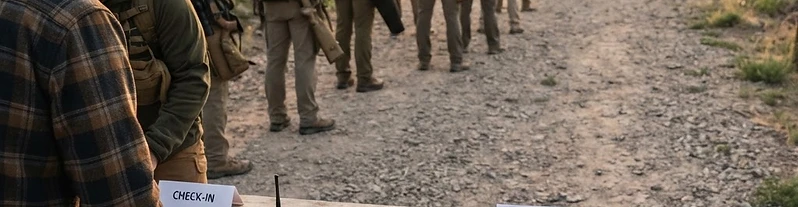
The single biggest bottleneck at a club rifle match is not the shooting. It is the table by the gate at 7:30 in the morning, where forty shooters arrive at once and every one of them has a question that only one person can answer.
A match can absorb a slow stage. It cannot absorb a slow check-in, because it delays the safety brief, which delays the first shot, which means the last squad is shooting into the afternoon and the whole day is behind.
Here is how to run that table so it takes ninety seconds a shooter.
What to collect before the day
The desk is fast when the information is already there. Collect on the entry form, not at the table:
- Name, and the account or email it is filed under
- Division or class
- The rifle details the format scores from — weight, caliber, bullet weight, velocity — where the match uses them
- Award tags: Lady, Junior, Senior, Veteran, Military/LE
- Waiver acceptance, dated
- Squad preference, and a partner if it is a Team Hunter match
- Anything they are buying beyond the entry fee: lunch, a shirt, a second entry
Then set a registration cutoff, print the roster sorted by name and by squad, and print the squad sheets. A desk working from a screen is fine. A desk working from a screen it has to search is not.
Squadding: the maths, then the feel
Start with capacity. Take your firing points and your relays and work out how many shooters can be on the line at once. That number, not comfort, sets squad size. If you have twenty points and four squads, five shooters a squad and it moves briskly. If you have eight points, a squad of ten is a queue with a name.
Then the parts that are judgement rather than arithmetic:
- Assign a start stage to every squad, and never let two squads open on the same target. This one habit removes more waiting than any other.
- Keep pairs, families and travelling partners together. A junior shoots in the squad of the adult who brought them, always.
- Spread experience. Four first-timers opening on the hardest stage costs the whole match an hour. Put one experienced shooter in the group and let them talk.
- Leave room for walk-ups. Two empty seats in the last squad is cheaper than re-cutting the whole board at 8:15.
- Lock it when you are done. Self-squadding is a good option for a club that likes it, right up until the moment somebody moves themselves into the squad that has already shot the stage.
The desk, in order
One queue, one owner, one answer per question. The sequence that works:
1. Find the name on the roster. If they are not on it, they are a walk-up — handle them as one, at the same table. 2. Confirm the division or class, and take the rifle data if the format needs it. 3. Mark the waiver. No signature, no card. 4. Take the money and mark them paid, with the method. Cash, card, Venmo, Zelle — it should end up on the entry, not in a notebook. 5. Hand over what they need: their card, their squad, their start stage. 6. Point them at the brief.
Nobody should be asked the same question twice by two different people. That is what makes a desk feel slow even when it is moving.
Weighing and chronographing
Where a format scores from rifle data — a Hunter 3-1-0 equity adjustment, an ELR division ceiling — the desk is the only place that data becomes trustworthy. Shooters declare their numbers at entry; the desk measures them on the day. Keep the measured velocity separate from the declared one rather than overwriting it, because a disagreement six hours later is much easier to settle when both figures still exist.
Have the scale and the chronograph set up before the first shooter arrives, not assembled while the second one waits.
Walk-ups
Decide the rule before the season starts and then apply it without discussion: take walk-ups until capacity, then waitlist them in order.
The important part is where they are entered. A walk-up goes into the same roster, at the same desk, marked paid the same way. A name on a scrap of paper is a shooter who will not be in the squads, will not be on the board, and will be an argument at results.
No-shows and the waitlist
At the cutoff, promote from the waitlist in order and tell the people you promoted. Do it early enough that they can still decide to come — a seat offered at 7:55 is a seat nobody can use.
Mark no-shows as no-shows rather than deleting them. If somebody paid and did not come, you want that on the record.
What the officers get handed
Before the brief, every officer should have: the squad list with names and start stages, one sheet per stage with the course of fire and the par times, and enough cards for the squad in front of them. An officer hunting for a target sheet mid-stage costs more time than any desk ever has.
The ten-minute rule
If check-in runs past the published brief time, start the brief anyway with the people who are there. Late arrivals get the brief individually, before they touch a rifle, and join their squad already in progress.
That one rule, applied at the first match of the season, teaches the field more about your start times than any email can. The clubs whose matches run on schedule are not the ones with the fastest desk. They are the ones that start on time even when the desk is not finished.
None of this needs a system to work — a good clipboard and a competent volunteer will beat a bad process every time. What a system buys you is that the roster, the money and the squads are one list, so the desk stops being the place where four versions of the truth meet.